
NEWS
September 7, 2026
IN BRIEF
SHARE
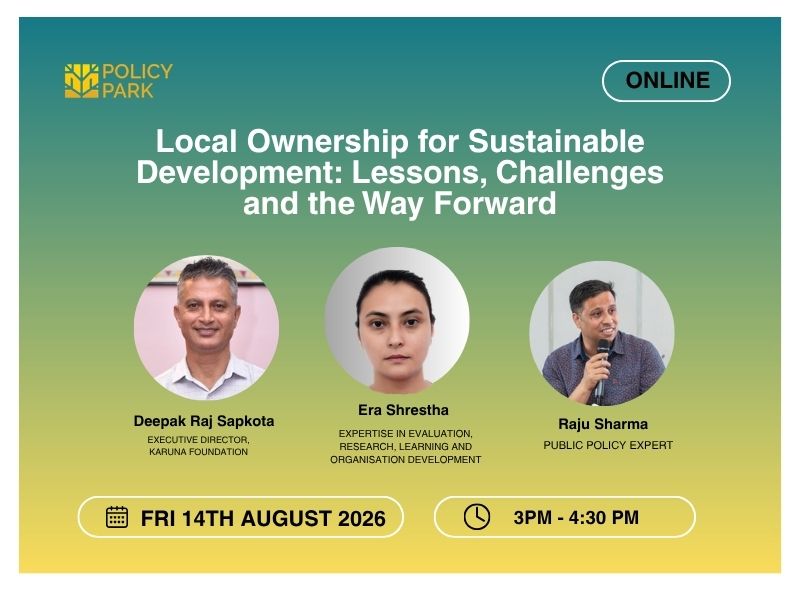
Dialogue Date: August 14, 2026
Speakers: Deepak Raj Sapkota, Executive Director, Karuna Foundation
Era Shrestha, Monitoring, Evaluation and Organizational Growth Consultant
Raju Sharma, Public Policy Expert
What does a successful NGO intervention model actually look like? Is treating local governments merely as consulting stakeholders enough? For decades, the development landscape of Nepal has been largely shaped by international development assistance and donor-funded projects implemented across sectors such as governance, education, health, inclusion, climate resilience and more. While these interventions have contributed significantly to national development, they have also raised important questions about sustainability, local ownership, and long-term impact. How much of the localization and ownership of such development works and how much of them are demand driven?
Such development programs should strengthen local capacities such that communities can sustain progress independently, even after external support ends. Sustainable change in institutions, education, socio-cultural norms, and local capacities cannot be achieved within a single project cycle; it depends on integrating project objectives into policies and everyday practice while fostering community and local government ownership. Success should therefore be measured not only by project outputs but by lasting outcomes, including resilient institutions, empowered citizens, and self-sustaining local systems.
This Policy Park brought in the expertise and development practitioners to discuss the practical experiences in building and institutionalizing the ownership in designing development strategies that are demand-driven, locally led, and move beyond traditional aid models. The discussion also focused on identifying the challenges and causes behind the struggle of development interventions in achieving long-term sustainability post-closure. Overall the policy park created a reflective space that critiqued the role of key stakeholders including NGOs/CBOs and jointly reimagined ways on shifting towards demand-driven, locally led, and sustainable systems.
Discussion Highlights
Q.1. What is Karuna Foundation’s Disability Prevention and Rehabilitation Program (DPRP)? Can you explain this especially in terms of stakeholder engagement, their ownership and role in making this a successful model?
Deepak Raj Sapkota:
There are two key organizational values that anchors every effort of Karuna Foundation, one is identification and engagement of who is accountable and responsible for addressing a particular issue or challenge and second, is the understanding that external support alone is insufficient to achieve sustainable reform.
Disability Prevention and Rehabilitation Program (DPRP) is the Karuna Foundation’s model which centers on disability prevention and rehabilitation. Following the organizational anchor, the programs focuses on developing appropriate mechanisms and infrastructure, alongside strengthening leadership within families and communities. Likewise it acknowledges the local government as the key stakeholder in the program and shares the implementation responsibility with them. The program creates the fund by adding their programmatic budget, contribution from the provincial funds and channels it directly through the municipalities. In this model, Karuna played the role of a catalyst, supporting local governments and increasing their ownership rather than directly implementing the program.
Implemented through a four-year plan, the program reached approximately 90,000+ people across 137 palikas in Koshi Province. A major learning from the program was the importance of understanding the capacity and commitment of government, as well as demonstrating that development interventions can be implemented differently when local institutions are given ownership and responsibility.
Building on these lessons, the program is now being implemented across Kenya, DRC and more and also considered for scaling to other provinces, with greater emphasis on strengthening government-led systems and ensuring that interventions can be sustained beyond external project support.
Q.2. Local Government is not a consultative agent but a deliberative agent. You have presented LG as a key architect to be engaged while building the theory of change of NGOs. What kind of tendencies are seen in the roles and relation of the NGOs and governments especially Local Government and where are the shortfalls?
Raju Sharma: Local governments are often treated as validating or consultative bodies rather than active actors in development programs. Problem analysis is sometimes conducted mainly to fulfil project requirements, and local governments are not adequately incorporated into the project’s theory of change. As a result, the projects may remain vibrant only during their implementation period, with limited sustainability or clear outcomes after project completion. This leads to projects being driven more by organizational or donor requirements than by long-term local needs.
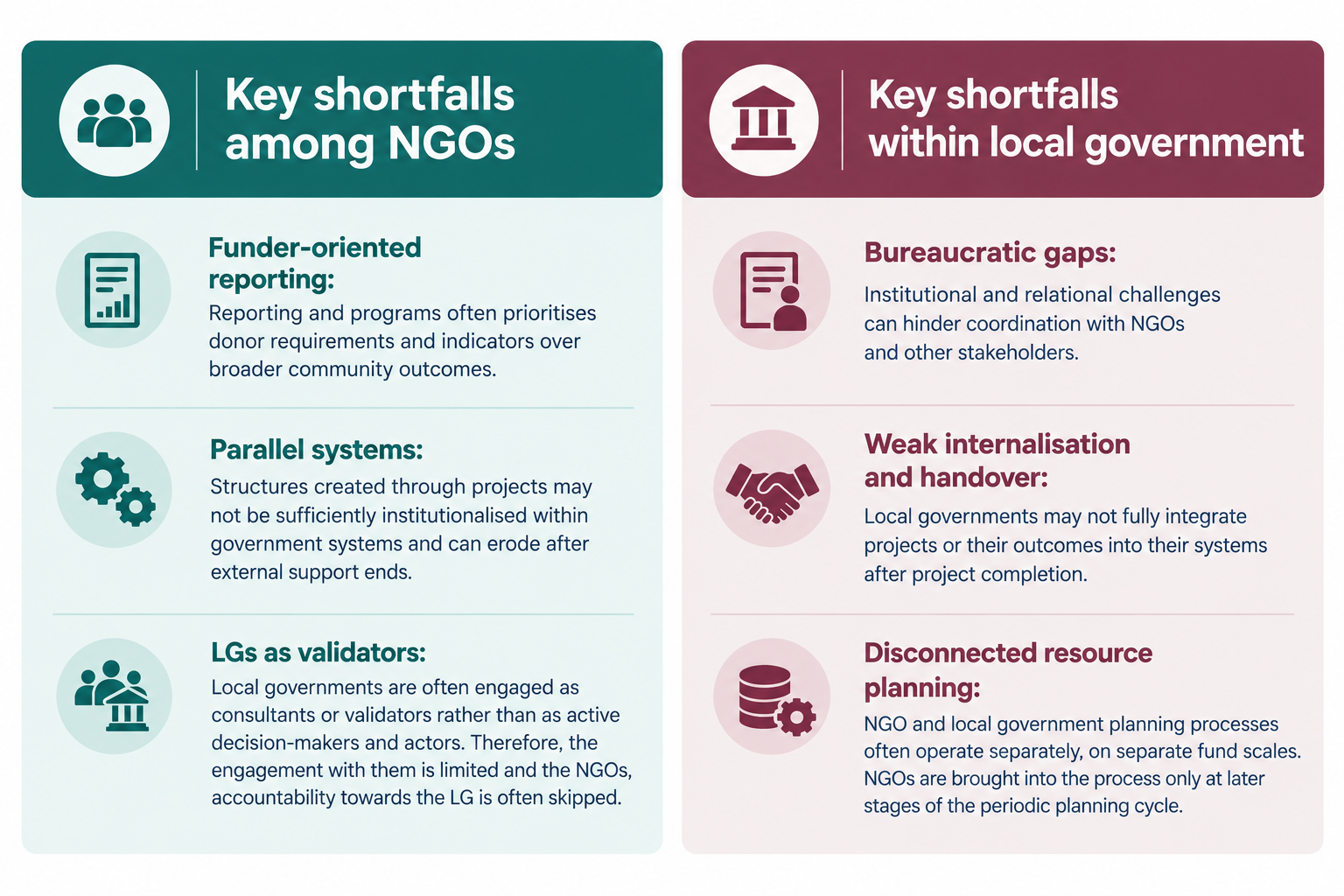
Overall, the emphasis should be on the need to engage local governments from the initial planning and problem-identification stages, positioning them as co-creators and actors throughout the project cycle rather than as end-stage validators.
Q.3. How does the fund and the dependency affect the organizational practices ? How are community based organizations operating to facilitate movement building in programmatic areas?
Era Shrestha: The external development assistance has made significant contributions to Nepal’s development, but the donor fund comes with conditionality’s which can constrain locally led and sustainable development. Donor priorities and foundational values may not always align with local realities, while conditionality’s can limit the flexibility of local organizations in using resources and determining how programs are implemented.
In the context of development ownership, financial reporting, indicators and compliance requirements are often prioritized over local needs and institutional priorities. Tight deliverables can limit organizations’ ability to respond to emerging community needs, while insufficient space for learning and reflection can reinforce a cycle of funding dependency and power imbalances, ultimately encouraging the acceptance of donor conditions as a default practice. With the high dependency and struggle to survive, the pleasing of donors is so ingrained that it is difficult to bring the CSOs out of it.
Era shared the context of “Doing Development Differently”. It was noted that while the approach emphasizes greater local ownership, there can still be a disconnect between the issues identified during the preliminary stages and the priorities ultimately presented to donors. In some cases, priorities may be shaped by donor interests to align projects with the funding, rather than to address fully with the community needs. This can also weaken trust between donors, implementing organizations and communities.
In this context it becomes important to rethink if funding should be considered the only meaningful development resource. Community philanthropy, local knowledge and community assets can also be mobilized to support development. Rather than viewing communities primarily through a lens of deprivation, development actors should recognize and build upon their existing resilience, resources and capacities, shifting the orientation from scarcity towards abundance.
Q.4. Why is Exit policy necessary in the design stage? How does prioritizing “Exit day policy” from the beginning of the project, impact on the sustainability and scalability of the project?
Deepak Raj Sapkota: Integrating an exit policy from the very beginning of the design stage is essential for fostering true sustainability. By prioritizing the “exit day” early on, organizations can move beyond temporary interventions and toward lasting change ensuring robust local ownership, as it requires involving municipalities from the start, allowing programs to align seamlessly with local priorities and existing capacities.
When these initiatives are embedded into official systems such as the provincial Line Ministry Budget Information System (LMBIS), they become institutionalized rather than dependent on the life of a specific project. This shift also redefines what success looks like; instead of measuring impact by how long a project can be kept running, success is measured by the creation of self-sustaining systems that local governments can manage and fund themselves within a few years.
Ultimately, this strategic planning treats the end of a project not as a failure or a loss of support, but as a planned and positive transition. It allows NGOs to act as true catalysts for change who focus on building community resilience, rather than becoming perpetual providers of aid that risk leaving a void once their funding runs out.
Q.5. While evaluating the projects and working with the multiple partners, what gaps have you identified in the operability of the NGOs, what kind of trends do you see recurring in the development sector?
Raju Sharma: One common trend in the development sector is that budgets are often allocated without enough consideration for long-term planning and sustainability. As a result, some projects continue to receive funding even when their relevance has declined or more sustainable alternatives exist. There are also inconsistencies and variations in how similar programs are designed and budgeted across organizations. For example, the cost of a scholarship ranges from NPR 3,000 to NPR 32,000 across different programs, while a quick assessment suggests that around NPR 8,320 per person may be sufficient. This amount could potentially be pooled through local resources, philanthropy, or community contributions indicating that existing local capacities and resources can be a reliable source over relying on international funding. Another example is eye care services, which was initially provided as a subsidized service but has gradually developed into a commercial service. This shows that we need to think differently about sustainability—identifying which services need continued external support and which can gradually generate resources or operate through local mechanisms.
Overall, it’s high time to think beyond project-based funding, set realistic benchmarks, explore domestic resource mobilization, and identify ways to make the activities more sustainable and less dependent on foreign aid.
Q.6. Are numbers always a good impact teller? How do we measure genuine impacts of development? What lens/ strategies/considerations should be incorporated in measuring the impact of a program in a way that it can be integrated into the local programming and practices? What is the real measuring metric to support co-creation among community level?
Era Shrestha: Different issues require different forms of measurement and assessment. Establishing a single, objective and standardized measurement framework may risk overlooking important contextual realities. The NGOs have the system of developing theory of change through which they beautifully sum their intervention through “if” and “then” modules. But this does not necessarily give the whole picture. Development indicators, reporting mechanisms and the identification of beneficiaries should not be designed exclusively from outside the community. Instead, community-centered measurement approaches should be developed to capture impact beyond numerical outcomes, while incorporating rights-based approaches, the needs of marginalized groups and locally identified priorities.
It is the responsibility of the NGOs to bring the nuances and complexities of the community through data that are overlooked by the local government. Drawing on her research on the vulnerability of children with disabilities to child marriage, she explained that initial interventions were largely shaped by existing metrics, including the lack of available data and the perceived need for further research. However, as the research progressed, it revealed additional and often overlooked vulnerabilities faced by children with disabilities. This demonstrated the limitations of relying solely on predefined indicators to understand complex social issues.
Conclusion
In summary, the Policy Park dialogue underscored a critical pivot in Nepal’s development landscape: shifting from transactional, donor-reliant models toward transformative, locally-led systems. By reimagining the role of local governments as active agents of change rather than mere validators, and by embedding sustainable “exit strategies” and demand-driven theory-of-change frameworks into the design of every project, development actors can better ensure that progress endures beyond the life of any single intervention. Ultimately, the way forward lies in mobilizing domestic resources, fostering community resilience, and aligning project objectives with local periodic planning, ensuring that development is not just done for the community, but successfully sustained by it.