
NEWS
July 1, 2026
IN BRIEF
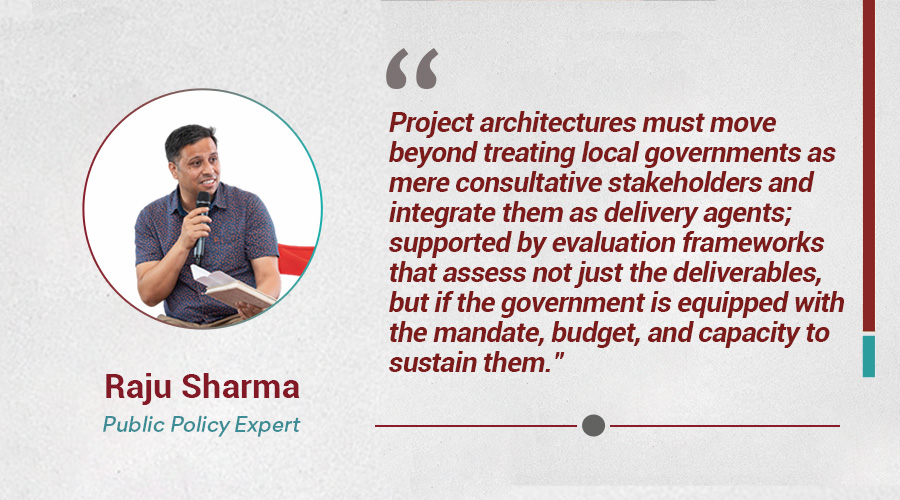
Raju SharmaPublic Policy Expert During my evaluation of an INGO-funded […]
SHARE
Raju Sharma
Public Policy Expert
During my evaluation of an INGO-funded project in a rural municipality in Koshi Province, the project reports highlighted health camps, wheelchair distributions, and training for the community health volunteers as achievements. The set targets and indicators were met, reports were filed, and the project was successfully concluded. But when I recently visited the same area, the health camps had not returned, the volunteers had dispersed, and the wheelchairs had no maintenance budget. The municipality knew the project had happened. They had simply never been asked to own it.
This is a recurring reality. Across Nepal’s development sector, ranging from TVET to livelihoods and disability inclusion to human rights, I have observed this pattern more frequently than I would have liked. Most projects are designed with communities as beneficiaries and local governments as background. Some projects draw up their exit plan to hand over the resources and files to the local government without establishing any link between the resources/capacity demanded by the project exit plan and the capacity of local governments to address such demands.
The existing federalism model practiced in Nepal provides an opportunity to break this pattern. The three-tier federal model allocates 22 exclusive rights to local governments covering every major service area—health, education, disability, market development, roads, irrigation, agriculture, disaster management, etc. It seems that the development sector has not understood what this differentiation and exclusive rights mean in practice. There are three concerns regarding the interplay between development sector project design methods and the rollout of the federal model in Nepal.
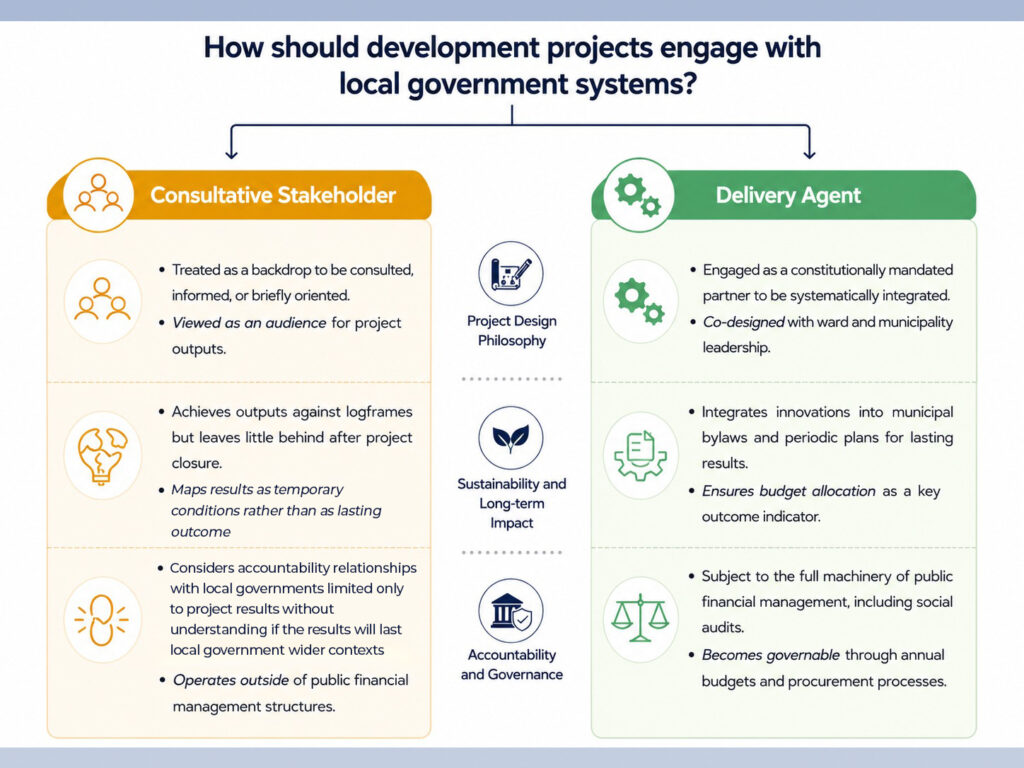
- Most development interventions treat this governance architecture as context and backdrop and assign local governments only evaluative and advisory roles. It is important to realize that local governments are the largest public service delivery systems in Nepal. Yet, the development intervention designs, reviewed by this author over the past decade, continue to treat them as a stakeholder category to be consulted, informed, or briefly oriented, rather than as a constitutionally mandated delivery agent to be systematically engaged. We need to move beyond treating local governments as consultative stakeholders to considering them as delivery agents in the project architecture. This calls for allocating defined roles, resources, and responsibilities that survive the project cycle. The difference between these two approaches is not subtle. The differences can be observed in, for instance, training women on financial literacy and ensuring these women access local governments’ saving schemes/programs even after three years of project closure. We should move beyond establishing community learning centers, a noble cause, no doubt, to having that center written into the municipal periodic plan with a ward-level budget allocation.
Projects that embedded local government as agents—co-designing with ward and municipality leadership, integrating innovations into municipal bylaws and periodic plans, and treating budget allocation as an outcome indicator—consistently demonstrated higher sustainability. Those that treated local officials as an audience achieved outputs against logframes and left little behind.
2. The accountability gap is the second dimension that receives insufficient attention. Development projects bypassing local government systems bypass accountability also. The accountability relationship between the community resources (trained human resources and community asset builds) developed by the development projects and the local government lasts till the projects are operational. When the project ends, so does the accountability relationship.
By contrast, when a project co-designs with local government and the resulting service is integrated into a municipal budget line, it becomes subject to the full machinery of public financial management—annual budgets, procurement processes, social audit provisions, and citizen oversight. The intervention becomes governable. If an output is achieved, it is not embedded in a system and should not be considered a result but rather a temporary condition. It is also true that development projects must bargain out a safe space between the capacity constraints in local governments and the resources demanded to maintain the pace of the project. However, this finding is not an argument for bypassing local government. Instead, it is an argument for building with them.
3. Development projects must acknowledge that federal structure is not a contextual variable to be described during the design of the project. More than that, it should be considered as a variable affecting the theory of change of the project. Whether a project outcome will be sustained after the funding cycle depends, to a significant degree, on whether the relevant local government has been engaged as an agent, not as an audience.
Conceptualizing the federal model as a variable affecting the theory of change has implications for the design of the project. The project logframe should design indicators for local government integration that go beyond ‘MoU signed’ or ‘orientation conducted. ‘Theories of change must illustrate the causal chain from project activities to municipal policy adoption to sustained outcome. Evaluation frameworks should not only ask whether outputs were delivered but also if the local government has the mandate, budget, and capacity to sustain the function.
This positioning of local governments has implications for how the development sector reflects on itself. Nepal’s evaluation community is increasingly collecting data on the six OECD-DAC criteria, including coherence. Coherence inquires about whether a program is reinforcing or undermining the systems it works within. Such a program that permanently circumvents local government structures does not match the constitutional architecture of Nepal. That’s not a philosophical position. It is an evaluable finding.
A call to development practitioners in the development sector
For development practitioners in the development sector, this structural understanding elevates the role of local government from a mere stakeholder to be dealt with to understanding local government as a delivery system. The project is the investment. The local government is the institution.
For donors, that means sustainability indicators in results frameworks must point to frontline findings of local government budget integration; policy adoption; or functional handover and not simply community satisfaction scores alone.
For civil society organizations and watchdog organizations, it implies that monitoring how local government absorbs development project results is an appropriate and serious accountability undertaking. Do local government programs and budgets support the allocations that development projects have planted? What about the elected officials? Do they know what is pledged on their behalf? These are civic monitoring questions, not donor reporting questions. This logic must be respected when designing programs in the development sector. This is not a compliance exercise but an architecture for sustainable change.